
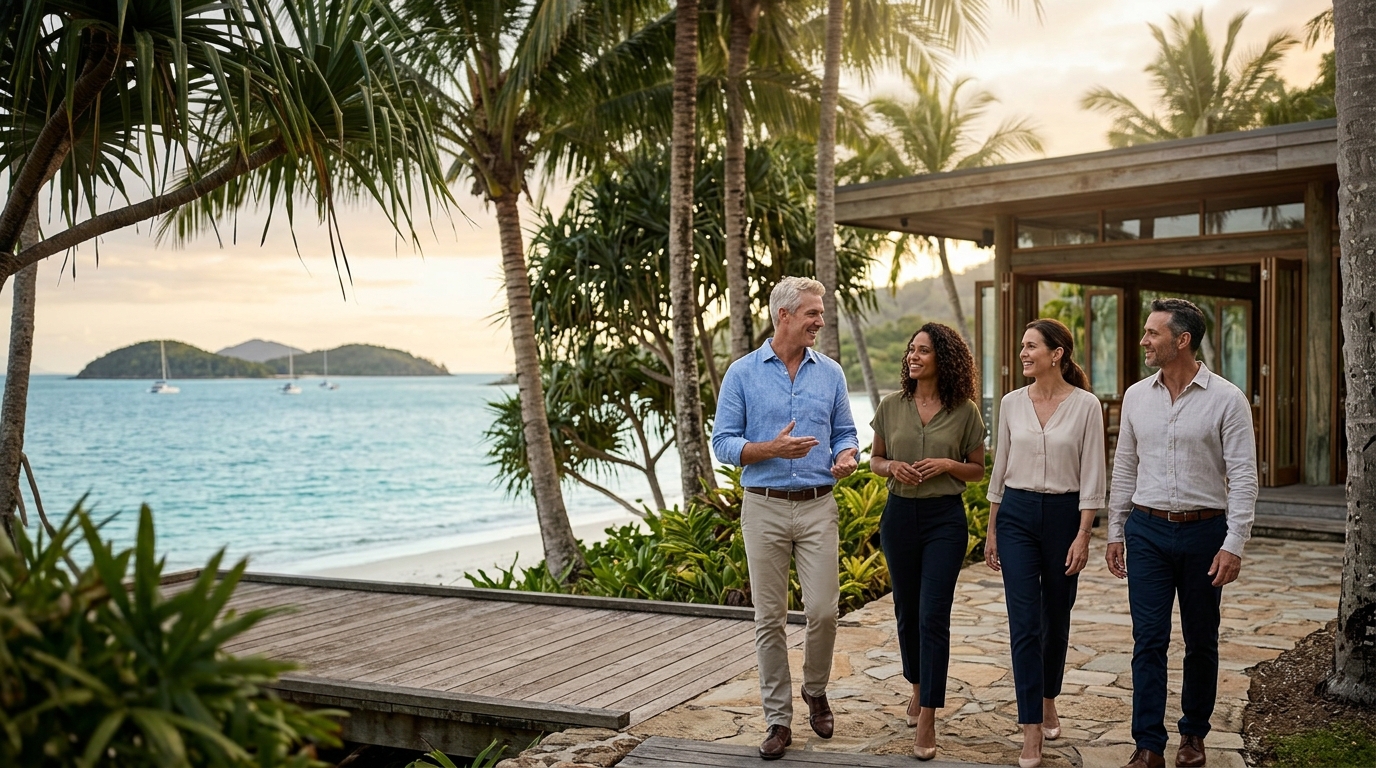
Leadership Retreat Planning Checklist: Cairns & Port Douglas Edition
Your executive team deserves more than another windowless boardroom session. A facilitated leadership retreat in Tropical North Queensland can reset strategy, rebuild trust, and re-energise senior leaders — but only if the planning is tight. Use this checklist to make sure nothing slips through the cracks.
Why Cairns and Port Douglas Belong on Your Shortlist
Before you open a spreadsheet, it helps to understand why this corner of Australia keeps attracting corporate groups. Cairns is a genuine gateway destination with an international airport that is easy to access for domestic and international delegates. Port Douglas, roughly an hour north, offers a more intimate resort-town feel with high-quality conference facilities suited to small and medium-size corporate events.
The region sits at the intersection of two World Heritage–listed areas — the Great Barrier Reef and the Daintree Rainforest — giving retreat organisers access to experiences you simply cannot replicate in a capital-city hotel.
Checklist Item 1 — Lock In Your Retreat Objectives Before Anything Else
Every dollar you spend on venue hire, flights, and facilitation should trace back to a clear set of outcomes. Before contacting a single supplier, answer this question in writing: "By the end of this retreat, our leadership team will…"
- Align on the three-year strategic direction
- Address specific cultural or communication gaps
- Develop individual leadership capability (e.g. behavioural profiling, coaching)
- Strengthen cross-functional trust through shared, high-impact experiences
Tip: Professional facilitation companies design programs oriented around identifying the current state of your business and its employees before contouring leadership development around your company's particular needs. Share your objectives early so the program can be tailored, not generic.
Checklist Item 2 — Choose the Right Time of Year
Tropical North Queensland runs on two distinct seasons rather than four. The dry season from May to October is widely considered the best window for corporate retreats. Expect sunny days, temperatures ranging from 20 to 28 degrees Celsius during the day, and minimal rainfall — perfect for outdoor strategy sessions, reef excursions, and evening networking.
For the best balance of weather, availability, and value, target the shoulder months of May, September, or October. Peak season from June to August coincides with school holidays and major cultural events, which drives up accommodation and tour prices. Book early if winter is your only option.
Checklist Item 3 — Match the Venue to Your Group Size and Format
The venue shapes the energy of the entire retreat. Here is a comparison of venue styles available in the region:
| Venue Style | Best For | Example |
|---|---|---|
| CBD convention hotel | Large groups (50–700), plenary + breakouts | Pullman Cairns International — 12 flexible function rooms, over 3,000 sqm of event space, 324 rooms |
| Boutique resort | Senior leadership teams (10–40), immersive feel | Port Douglas resort properties with dedicated conference rooms and beachfront access |
| Island venue | Total immersion, mid-size groups (20–100) | Fitzroy Island Resort — 45-minute ferry from Cairns, on-island accommodation and meeting spaces |
| Unique experience venue | Gala dinner, cultural immersion, wow-factor | Flames of the Forest — hand-strung chandeliers in ancient rainforest, capacity up to 850 |
| Reef pontoon | Incentive events, experiential team building | Sunlover Reef Cruises Arlington Reef Pontoon — first dedicated event space on the Great Barrier Reef, capacity 300 cocktail |
Ask every venue about AV capabilities, Wi-Fi reliability, breakout room options, and wet-weather contingencies. Tropical weather is generally predictable in dry season, but flexibility matters.
Checklist Item 4 — Engage Professional Facilitators Early
This is the step most organisations either skip or leave too late. A professional facilitator is not simply someone with a microphone — they are the ones making sure everyone else's voice is actually heard. They guide discussions, manage group dynamics, and keep sessions anchored to outcomes.
What to look for in a facilitator or facilitation partner
- Experience with leadership groups: Look for providers whose trainers are experienced in delivering leadership development courses and who can work with your event planning team to deliver a program from start to finish.
- Customisation: Avoid off-the-shelf agendas. The best providers design events around your team, culture, and what you want out of the experience — not the other way around.
- On-the-ground capability: Choose companies with experienced facilitators and event hosts located around Australia who can deliver in regional locations without compromising quality.
- Combination format: An effective approach includes a combination of lesson facilitation from a leadership expert along with team experiences designed to reinforce the course content. This blended model keeps energy high across a multi-day retreat.
Engage your facilitator at least 8–12 weeks before the retreat so there is time for a discovery call, pre-retreat surveys, and agenda co-design.
Checklist Item 5 — Design the Agenda Around Energy, Not Just Content
A common mistake is cramming every strategic topic into a two-day schedule. Leadership retreats need rhythm — alternating between deep strategic work, experiential team building, individual reflection, and social connection.
Sample two-day agenda skeleton
| Time Block | Day 1 | Day 2 |
|---|---|---|
| Morning (8:30–12:00) | Facilitated strategy session — vision, priorities, OKRs | Behavioural profiling workshop with personal survey debrief |
| Lunch (12:00–13:30) | Catered lunch, informal networking | Reef cruise departure or rainforest walk |
| Afternoon (13:30–17:00) | Team building experience — creative or purpose-driven activity | Action planning and accountability pairing |
| Evening | Group dinner at unique venue (e.g. rainforest dining) | Free time or optional social activity |
Notice how the most cognitively demanding work sits in morning blocks when mental energy is highest. Experiential sessions after lunch counter the post-meal slump and create shared memories that reinforce strategic themes.
Checklist Item 6 — Layer In Experiences That Only This Region Can Offer
The whole point of leaving the office is to create context-dependent memories that stick. Tropical North Queensland delivers experiences that double as metaphors for leadership:
- Great Barrier Reef snorkelling or diving: Navigating an unfamiliar environment together builds trust quickly. Calm, clear water conditions during dry season make this accessible for all fitness levels.
- Daintree Rainforest immersion: Guided walks through the world's oldest rainforest offer natural opportunities for reflection, paired walking conversations, and digital detox.
- Indigenous cultural workshops: Work with renowned Indigenous artists to learn about Aboriginal art before creating your own artwork that tells your leadership story. These sessions deliver meaningful cross-cultural learning.
- Breathwork and ice-bath challenge: A bold option that focuses on mindset, resilience, and conquering discomfort together — suitable for all fitness levels with professional facilitation and safety support.
- Purpose-driven team building: Activities like building and donating kids' bikes combine collaboration with genuine community impact, giving leaders a shared experience that goes beyond competition.
Checklist Item 7 — Set a Realistic Budget (and Know What Is Deductible)
Budgets for facilitated leadership retreats in Australia vary widely depending on format, location, and inclusions. Here are general per-person benchmarks:
- Facilitated activity only (1–2 hours): $40–$80 per person
- Mid-range facilitated session with equipment and multiple staff (half day): $100–$170 per person
- Full-day package including venue hire, food, drinks, and AV: $170–$350 per person
For regional destinations like Cairns or Port Douglas, factor in travel charges if your facilitators are based in a capital city. Some providers have facilitators located nationally, which can reduce or eliminate travel surcharges.
Tax considerations
A significant amount of team building activity can be written off as staff training or development, and those expenses are usually deductible. However, if the activity is more social or entertainment-centric — like a winery tour with lunch — it could attract Fringe Benefits Tax. Always confirm with your accountant, and position the event as skills-based or developmental where that genuinely reflects the content.
Checklist Item 8 — Handle Pre-Retreat Communication and Logistics
The retreat experience starts well before the plane lands. A solid pre-retreat communication plan should cover:
- Pre-retreat survey: Have your facilitator distribute a brief diagnostic survey 3–4 weeks out. This shapes the agenda and gives participants a sense of ownership.
- Travel and accommodation brief: Share flight options, hotel details, packing suggestions (reef-ready swimwear, sun protection, smart-casual for dinners), and the daily schedule.
- Expectations document: Communicate what the retreat is and is not. Set clear ground rules — devices off during sessions, assume positive intent, one mic at a time.
- Dietary and accessibility requirements: Collect these early so catering and activity providers can accommodate everyone.
Checklist Item 9 — Capture Outcomes and Build Accountability
The most expensive retreat mistake is not the spend itself — it is failing to translate energy into action once everyone returns to the office. Before participants leave the venue:
- Document the top three to five strategic commitments on a single page
- Pair each leader with an accountability partner
- Schedule a 30-day follow-up session (virtual is fine) to review progress
- Collect immediate feedback through a short post-event survey — post-event surveys can show powerful results, with leading providers reporting that 97% of attendees agreed they connected with their team on a deeper level
Share a professional photo and video recap within 48 hours. This reinforces the emotional high of the retreat and gives participants something tangible to reference.
Checklist Item 10 — Evaluate ROI and Plan the Next One
Leadership retreats are not one-off events — they are part of a continuous development cadence. After your Cairns or Port Douglas retreat, evaluate return on investment through:
- Engagement metrics: Has team engagement shifted in pulse surveys?
- Retention: Enjoyable and meaningful events raise morale and retention rates over the following quarter.
- Leadership pipeline: Did the retreat surface emerging leaders? In team activities, unexpected attendees often shine as leadership candidates.
- Strategic progress: Are the commitments made during the retreat translating into measurable business outcomes?
Use these insights to refine timing, format, and facilitation for the next retreat — and consider rotating between Cairns and Port Douglas to keep the experience fresh.
Quick-Reference Planning Timeline
| Weeks Out | Action |
|---|---|
| 16–20 weeks | Define objectives, set budget, shortlist dates |
| 12–16 weeks | Book venue and accommodation, engage facilitator |
| 8–12 weeks | Co-design agenda with facilitator, book flights and experiences |
| 4–6 weeks | Distribute pre-retreat survey, send travel brief |
| 2 weeks | Confirm all suppliers, finalise dietary needs, print materials |
| Retreat days | Execute, capture outcomes, collect feedback |
| 2–4 weeks after | Share recap, hold accountability check-in, evaluate ROI |
Frequently Asked Questions
When is the best time of year to hold a leadership retreat in Cairns or Port Douglas?
The dry season from May to October is ideal. Daytime temperatures generally range from 20 °C to 30 °C with mostly sunny days and relatively lower humidity. For the best combination of weather, availability, and price, target late April, May, September, or October — these shoulder months see fewer crowds and better rates than peak winter.
How much does a facilitated team building retreat cost per person?
Short activities run $40–$80 per person, mid-range facilitated half-day sessions cost $100–$170 per person, and full-day packaged events including venue, catering, and AV sit between $170–$350 per person. Regional travel charges may apply if facilitators are travelling from a capital city.
Why use a professional facilitator instead of running the retreat ourselves?
A facilitator is a neutral guide focused on process, not content politics. They create the space where every voice is heard, manage energy and time, and can pivot activities in real time based on group dynamics. Organisations that invest in professional facilitation consistently report stronger engagement, clearer outcomes, and higher participant satisfaction than self-run offsites.
Can leadership retreat costs be claimed as a tax deduction?
Team building positioned as staff training or development is generally deductible. Events that lean more toward entertainment may attract Fringe Benefits Tax. Position the event as skills-based where it genuinely is, and always confirm with your accountant before claiming.
What unique venue options exist near Cairns and Port Douglas?
Beyond traditional conference hotels, you can host events on the Great Barrier Reef via the Sunlover Reef Cruises pontoon, dine under chandeliers in ancient rainforest at Flames of the Forest, retreat to Fitzroy Island for total immersion, or choose luxury beachfront properties in Port Douglas with dedicated event spaces and concierge support.