
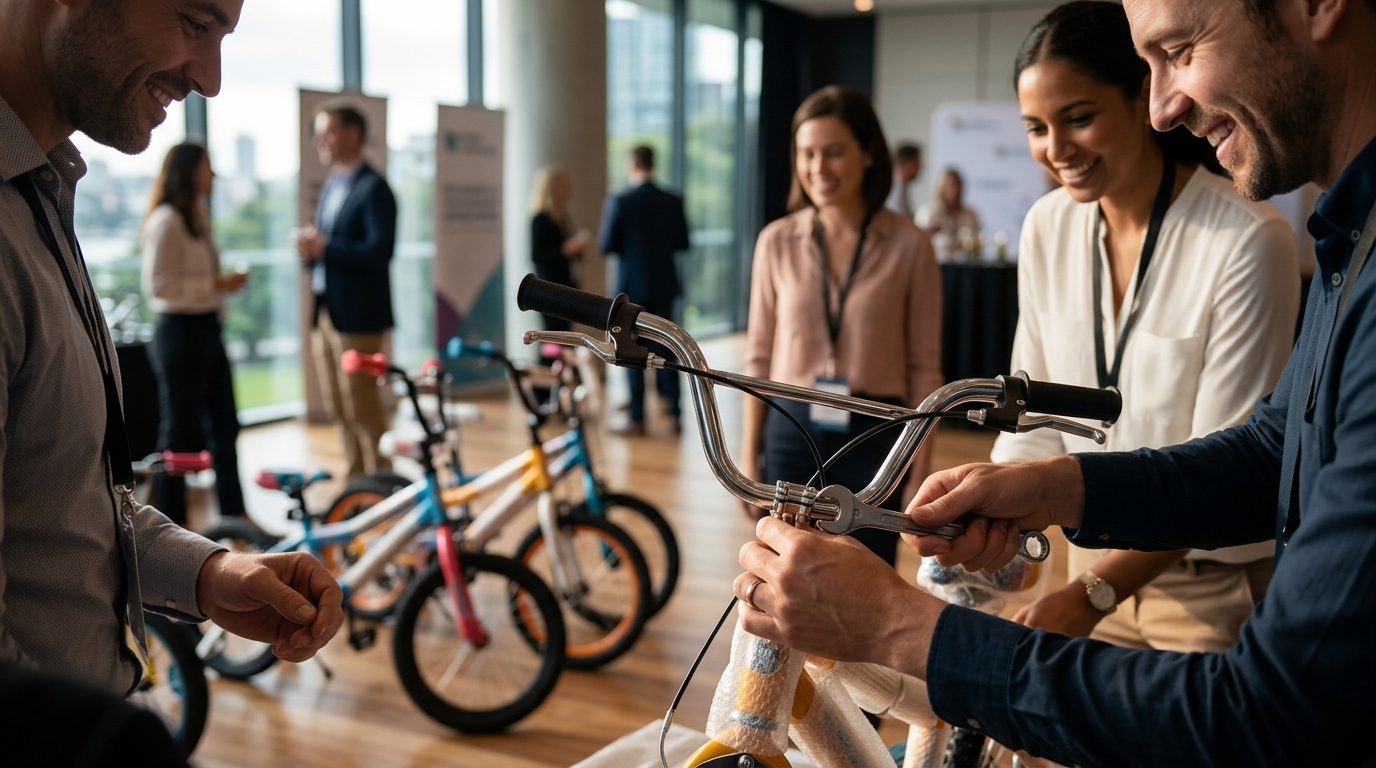
A charity bike building event is a corporate team building activity where conference delegates work in small teams to assemble children's bicycles that are then donated to a charity partner. It combines hands-on collaboration with genuine social impact, making it one of the most rewarding breakout sessions you can add to a large conference agenda. Whether you are coordinating 30 people or 300, the planning process follows the same core steps. This guide walks you through every stage, from setting objectives and choosing a provider to logistics on the day and post-event follow-up, so your charity bike build delivers results for your team and your community.
Why Charity Bike Builds Work at Conferences
Corporate Social Responsibility (CSR) is the practice of a company taking responsibility for its impact on the community. A charity bike build turns that concept into a tangible, shared experience. Research cited by Harvard Business Review suggests that positive social interactions at work account for more than 50% of communication improvements, which is exactly the outcome conference organisers seek.
Charity bike builds also suit large groups exceptionally well. Teams of four to six people each work on one bike, meaning a conference of 200 delegates can realistically produce 35 to 40 fully assembled bicycles in under two hours. The visual payoff of dozens of colourful bikes lined up at the end of a session creates a moment delegates remember long after the conference wraps.
Step 1: Set Clear Objectives
Before you book anything, define what success looks like. Are you trying to energise delegates after a day of presentations? Strengthen cross-department relationships? Demonstrate your company's commitment to community giving? Your objectives shape every downstream decision, from timing and team composition to how you brief the facilitator.
Experienced charity team building providers will tailor the experience to your goals. If collaboration is the priority, the facilitator can design challenges that force inter-team cooperation. If the CSR message matters most, more time can be allocated to the donation ceremony.
Step 2: Choose the Right Provider
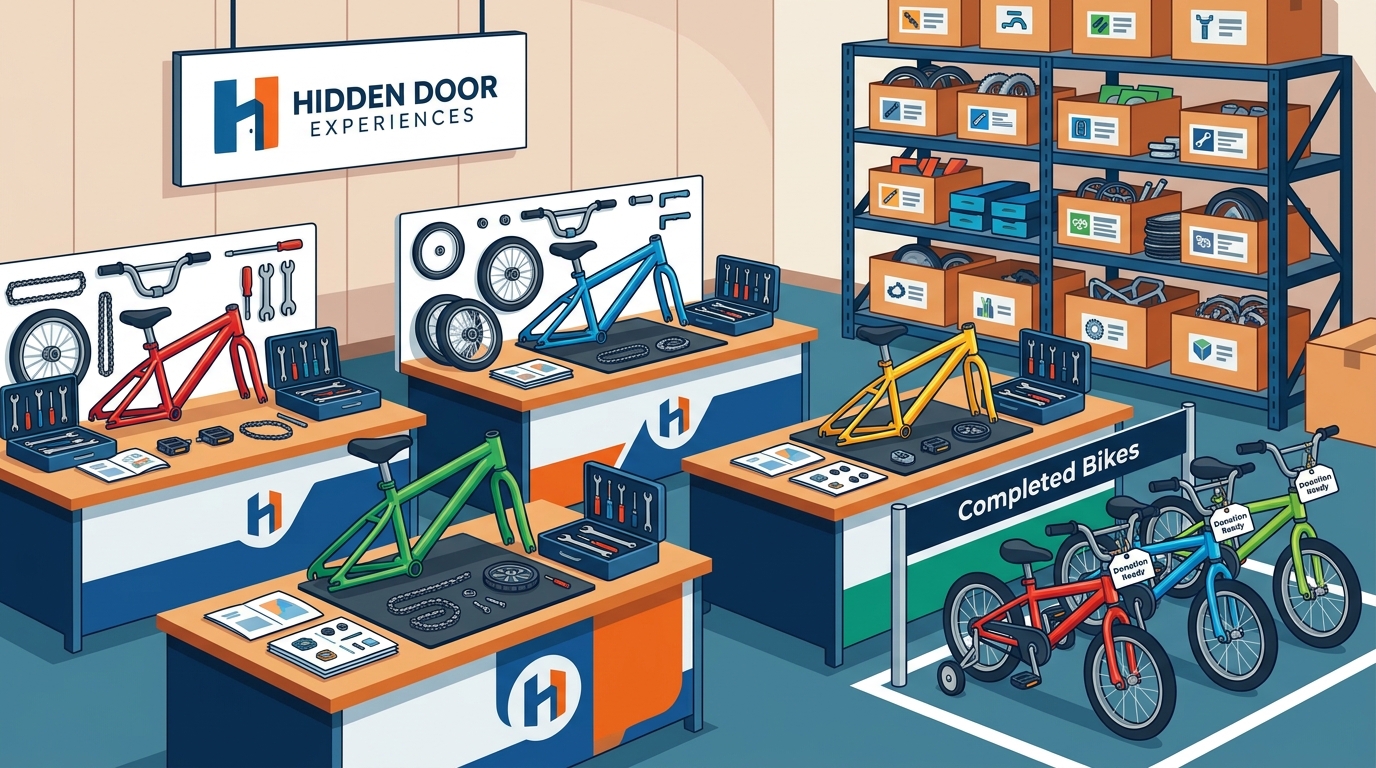
Not every team building company can deliver a bike build at conference scale. Look for a provider with specific bike build experience, their own equipment inventory, qualified bike mechanics, and established charity partnerships. A professional provider handles everything from sourcing bike frames and tools to conducting safety inspections on every completed bicycle.
Hidden Door Experiences, for example, has donated over 3,500 bikes through its Bikes 4 Tykes program over 15 years. Their team brings bike stands, tools, and a qualified mechanic to every event. They also discuss sizing needs with their charity partner before each build to ensure donations meet an immediate need.
What to Ask Before Signing
- How many bike builds have you delivered for groups over 100 people?
- Do you provide on-site bike mechanics for safety checks?
- Can you work with our preferred charity, or do you have established partners?
- What venue requirements do you need (space, power, access)?
| Factor | DIY Approach | Professional Provider |
|---|---|---|
| Bike sourcing | You source and transport | Provider supplies and delivers |
| Tools and equipment | Purchased or hired separately | Included in package |
| Safety inspection | Arrange your own mechanic | Qualified mechanic on-site |
| Facilitation | Internal staff | Professional host and crew |
| Charity coordination | You manage directly | Provider manages relationship |
| Typical lead time | 8+ weeks | 4-6 weeks |
| Risk and insurance | Your responsibility | Covered by provider |
Step 3: Nail the Logistics
Venue and Space
A bike build needs more room than you might expect. Plan for roughly 3 to 4 square metres per team, plus space for bike stands and a central staging area. Conference centres, hotel ballrooms, and large outdoor spaces all work well. As noted on the Build a Bike activity page, you do not necessarily need a formal venue for an outdoor build.
Timing Within the Agenda
Position your bike build after lunch when energy is high and people are ready to move. Avoid squeezing it into the last 45 minutes of the day. Most builds run between 90 minutes and two and a half hours depending on group size and whether you include pre-build challenges. For guidance on integrating team activities into a broader event, see our tips on planning corporate events in Sydney.
Team Size and Composition
Teams of four to six people per bike are optimal. Mix departments and seniority levels deliberately. Random team allocation breaks down silos and creates new connections, which is one of the primary benefits of any collaboration-based team building activity.
Step 4: Structure the Experience
The best charity bike builds follow a three-phase structure that keeps energy high throughout.
Phase 1: Warm-Up Challenges (20-30 min)
Teams compete in bike-themed trivia, physical mini-challenges, and problem-solving tasks to earn bike parts and tools. This competitive element builds excitement and gives every team member a role regardless of mechanical ability.
Phase 2: The Build (30-45 min)
Teams assemble their bikes using the parts they have earned. An on-site mechanic circulates to offer guidance and conduct safety checks. Even participants who have never picked up a spanner can contribute, and professional facilitation ensures nobody is left standing idle.
Phase 3: Donation Ceremony (10-15 min)
This is the emotional peak of the event. Some providers arrange for charity representatives or recipient families to attend. Others share photos and letters from previous recipients to close the experience on a meaningful note. Either way, this moment transforms the activity from fun into something genuinely memorable.
Step 5: Coordinate With Your Charity Partner
A charity partner is the organisation that receives and distributes the completed bikes to families in need. Early coordination is essential. Discuss sizing requirements (children's ages change seasonal demand), pick-up or delivery logistics, and whether the charity can send a representative on the day.
In Sydney, Hidden Door Experiences partners with Weave, an organisation that supports families across the city. Before each event, they confirm what sizes are most needed so that every bike meets an immediate demand. If your company has a preferred charity, most reputable providers are happy to work with them instead. Browse other team building activities that include a CSR component for alternative charity formats.
Step 6: Maximise Post-Event Impact
The event does not end when the last bike rolls away. Share photos and a thank-you letter from the charity with all delegates within a week. Feature the build in your internal newsletter or company social channels. This reinforces the shared achievement and extends the positive sentiment well beyond conference day.
Encourage leadership to reference the experience in future communications. Linking the bike build back to company values makes it more than a one-off activity. It becomes part of your culture narrative. For teams that want to maintain momentum, regular team building experiences throughout the year keep engagement high.
Key Takeaways
- A charity bike build is a CSR team building activity where delegates assemble children's bikes for donation, combining teamwork with community impact.
- Define your objectives first. Collaboration, CSR messaging, and team bonding each require different event structures.
- Use a professional provider with bike mechanics, insurance, and established charity relationships to reduce risk.
- Allow 90 minutes to 2.5 hours and position the activity after lunch for maximum energy.
- Teams of 4-6 people per bike are ideal. Mix departments to break down silos.
- Coordinate with your charity partner early to match bike sizes to current need.
- Amplify the impact by sharing photos, thank-you letters, and stories after the event.
Frequently Asked Questions
How many people do you need for a charity bike build?
Most bike builds work well with groups of 20 to 500 people. Teams of four to six people are assigned to each bike, so a group of 100 would typically build around 20 bicycles.
How long does a charity bike building event take?
A complete experience, including warm-up challenges, the build, and a donation ceremony, typically runs between 90 minutes and 2.5 hours depending on group size and format.
Do participants need mechanical skills?
No. Professional providers supply all tools and have mechanics on-site to guide teams and inspect every bike before it is donated. The activity is designed for people of all skill levels.
Can a bike build work indoors at a conference centre?
Yes. Bike builds can be delivered indoors or outdoors. The main requirement is enough floor space for teams and bike stands to move around comfortably, roughly 3-4 square metres per team.
What happens to the bikes after the event?
Every bike is checked by a qualified mechanic and then transported to the charity partner for distribution. Participants typically receive a thank-you letter and photos from the charity afterwards.
How far in advance should I book?
For large conference events, booking six to eight weeks ahead is recommended. Peak conference season in Australia runs from September to November and February to April, so earlier is better during those periods.
Can we choose our own charity to receive the bikes?
Most professional providers are happy to work with your preferred charity. Alternatively, they can connect you with their established charity partners who are set up to receive and distribute bikes efficiently.
How much does a charity bike build cost per person?
Pricing varies depending on group size, location, and inclusions. As a general guide for corporate team building in Australia, expect around $50 to $250 per person depending on the experience level and logistics involved.
Ready to Build Bikes at Your Next Conference?
A charity bike build is one of the most impactful activities you can add to a conference agenda. It brings people together, breaks down barriers between departments, and leaves a lasting impression on both your team and the community. Get in touch with Hidden Door Experiences to start planning your Bikes 4 Tykes event today. Their team will handle the bikes, the tools, the mechanics, and the charity coordination so you can focus on your conference.