
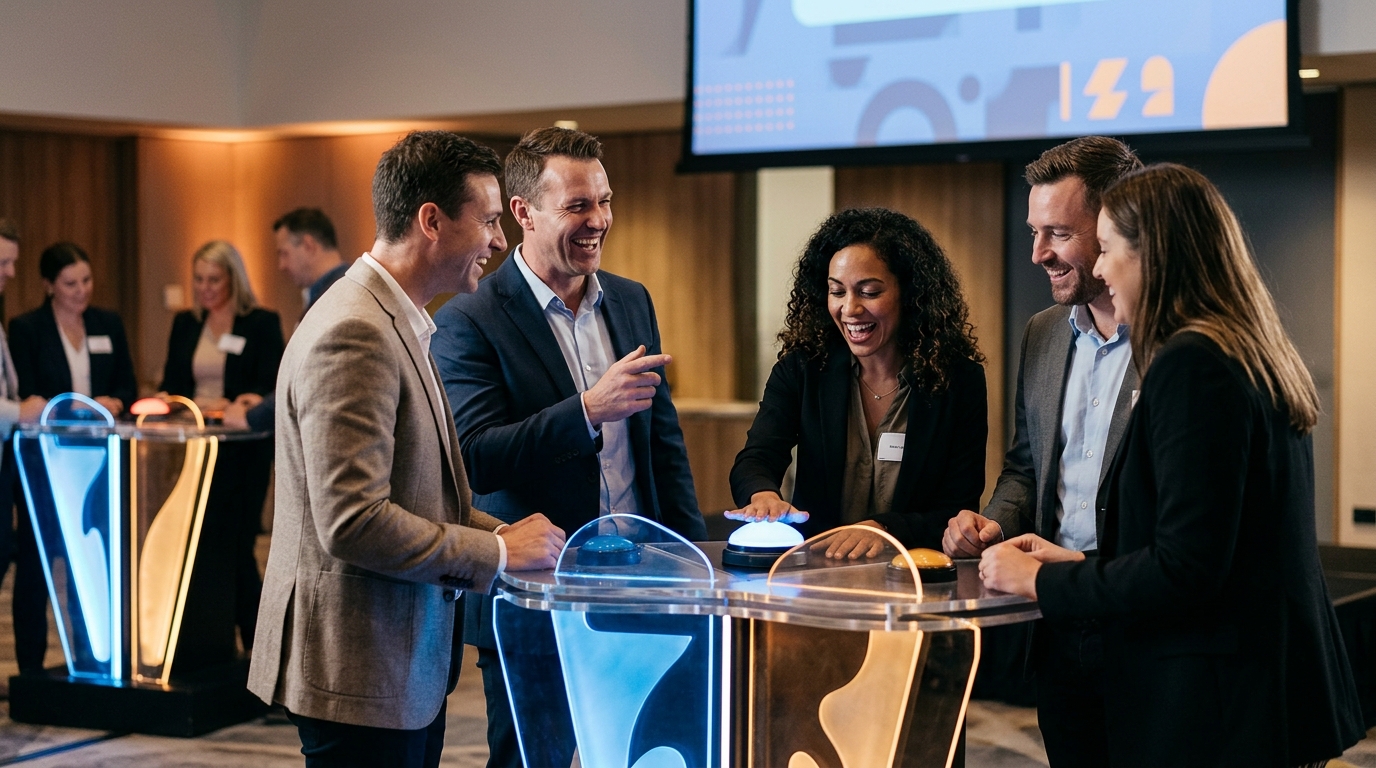
Modern organizations invest heavily in structured group activities to reverse declining workplace engagement. According to a 2024 Harvard Business Review analysis, companies that implement regular interactive programming see a 23 percent increase in cross-departmental collaboration. This statistical reality forces leaders to choose between highly controlled formats and unstructured urban exploration. The decision between corporate game shows and outdoor city scavenger hunts directly impacts how teams process information and build trust. Understanding the operational differences prevents wasted budget and guarantees measurable cultural impact. (Is Your Workplace)
Core Mechanics and Operational Design
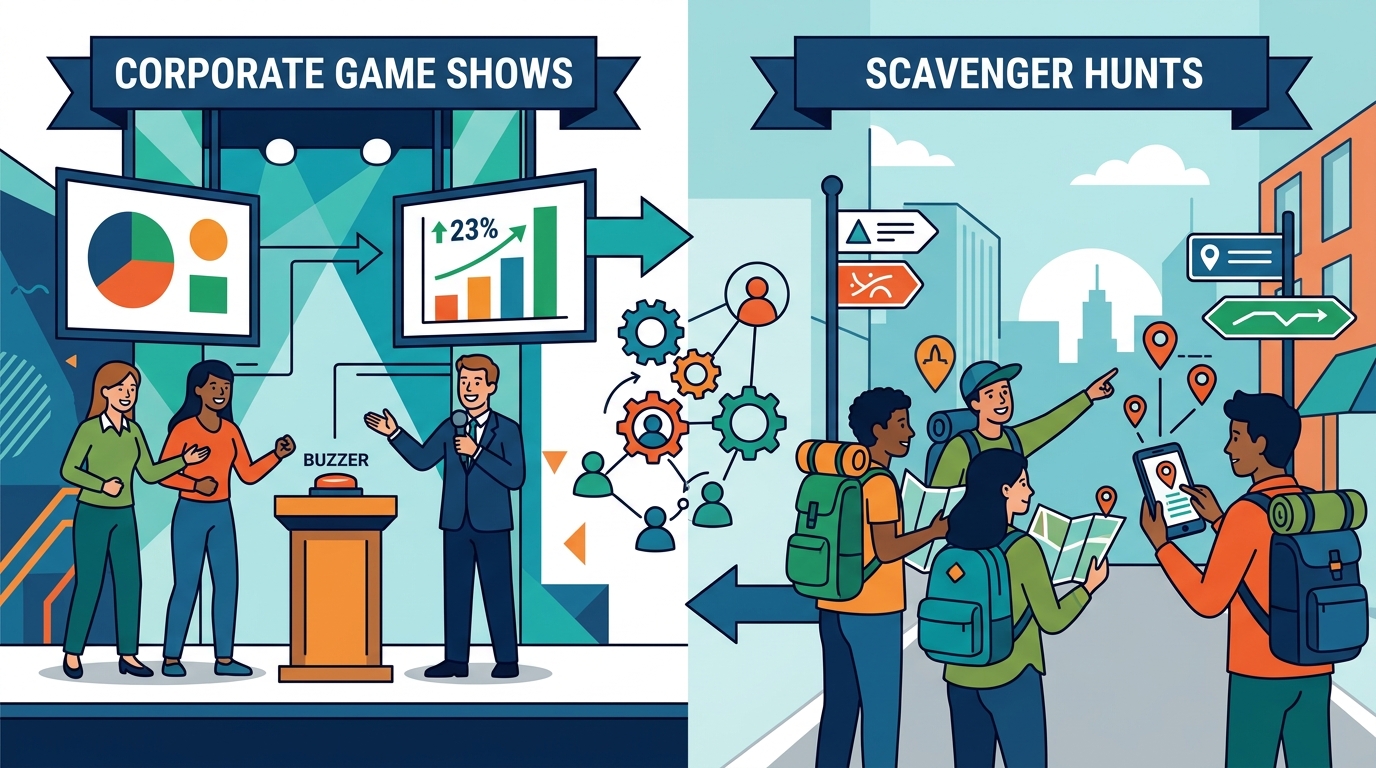
Corporate game shows operate within a controlled environment where facilitators dictate the pace and flow. Participants compete in structured rounds that mimic television formats. This format requires rapid recall and synchronized decision making. A corporate game show is a structured competitive activity where teams answer prompts or complete challenges under timed conditions. The environment minimizes external variables and keeps focus strictly on interpersonal dynamics.
Outdoor city scavenger hunts function as decentralized field operations. Teams navigate predefined urban zones while solving location-based puzzles. This format requires spatial awareness and route optimization. A city scavenger hunt is an outdoor navigation activity where groups solve sequential clues to reach designated checkpoints across a metropolitan area. The environment introduces weather variables and public space logistics.
Game Show Dynamics
Hosted events utilize professional moderators who manage scoring and pacing. Teams rotate through stations or remain seated while answering questions. The format emphasizes verbal communication and quick consensus building. Organizations seeking predictable outcomes often prefer this model.
Scavenger Hunt Logistics
Field coordinators distribute digital or physical clue packets at the start. Groups operate independently until the final convergence point. The format emphasizes spatial reasoning and adaptive planning. Organizations seeking authentic field testing often prefer this model.
Cognitive Load and Skill Application
Both formats demand high cognitive engagement but target different neural pathways. Leaders must align activity design with specific organizational objectives. The wrong format can create friction instead of cohesion.
Rapid Problem Solving
Game shows compress complex scenarios into short answer windows. Teams must synthesize information under artificial time pressure. This mirrors high-stakes corporate decision making. Participants practice active listening and rapid consensus building.
Strategic Route Planning
Scavenger hunts require long-term resource allocation and risk assessment. Teams must balance speed against accuracy across multiple checkpoints. This mirrors complex project management workflows. Participants practice adaptive planning and contingency execution.
Communication Patterns and Team Dynamics
Internal communication styles shift dramatically based on the chosen format. Leaders should map existing team behaviors to the appropriate activity structure. Mismatched formats create unnecessary friction. (Is Your Workplace)
Collaborative Pitching
Game show formats reward unified group answers and shared responsibility. Individual expertise becomes less relevant than collective agreement. This structure flattens hierarchical barriers and encourages peer validation. Teams learn to defer to the strongest logical argument.
Decentralized Coordination
Scavenger hunt formats reward distributed leadership and role specialization. Different members naturally assume navigation, research, or execution roles. This structure mirrors modern agile project workflows. Teams learn to trust delegated authority and asynchronous updates.
Environmental Factors and Accessibility
Physical location dictates participant comfort and safety parameters. Organizers must evaluate accessibility requirements before booking. Weather contingencies and venue restrictions directly impact success rates.
Controlled Indoor Settings
Indoor venues provide climate control and predictable acoustics. Facilitators can adjust difficulty in real time based on group performance. This model guarantees consistent participation across all skill levels. Organizations with mixed mobility requirements often select this option.
Unpredictable Urban Terrain
Outdoor programs expose teams to variable weather and public foot traffic. Groups must navigate intersections, transit hubs, and restricted zones. This model builds resilience and adaptability under real world conditions. Organizations seeking authentic field testing often select this option.
Measuring Return on Investment
Leadership teams require concrete metrics to justify program expenditures. Both formats generate distinct behavioral data that managers can track. The chosen activity must align with quarterly performance goals.
Engagement Metrics
Game shows generate immediate participation data through scoring dashboards. Facilitators track response times and accuracy rates across rounds. This data reveals individual knowledge gaps and group synchronization levels. Organizations seeking quantifiable participation metrics often select this model.
Long-Term Behavioral Shifts
Scavenger hunts generate longitudinal data through post-event surveys and project tracking. Managers observe how teams handle ambiguity and delegate tasks in daily operations. This data reveals adaptive capacity and cross-functional trust. Organizations seeking cultural transformation often select this model.
Activity Comparison Matrix
| Feature Category | Corporate Game Shows | Outdoor City Scavenger Hunts |
|---|---|---|
| Primary Environment | Controlled indoor venues with climate regulation | Unpredictable urban zones with variable weather |
| Decision Making Style | Rapid consensus building under timed pressure | Distributed role specialization across checkpoints |
| Leadership Structure | Flattened hierarchy encouraging peer validation | Adaptive delegation mirroring agile workflows |
| Best Use Case | High-stakes training and cross-departmental alignment | Resilience building and complex project simulation |
Key Takeaways
- Organizations implementing structured group programming report a 23 percent increase in cross-departmental collaboration according to 2024 industry benchmarks.
- Corporate game shows prioritize rapid consensus building and flattened hierarchical communication patterns.
- Outdoor city scavenger hunts emphasize distributed leadership and adaptive route optimization across urban zones.
- Indoor formats guarantee climate control and real-time difficulty adjustment for mixed mobility groups.
- Field programs expose teams to variable weather and public traffic to build authentic resilience.
- Scoring dashboards provide immediate participation metrics for game show environments.
- Post-event surveys track longitudinal behavioral shifts for outdoor navigation programs.
Frequently Asked Questions
Which format works best for large groups exceeding fifty participants?
Large groups perform optimally in corporate game shows because facilitators can manage pacing across multiple stations. Scavenger hunts require strict checkpoint monitoring to prevent group dispersion. Organizers should select indoor formats for maximum coordination control.
How do weather contingencies impact outdoor program scheduling?
Outdoor programs require backup indoor venues or flexible rescheduling windows. Coordinators monitor meteorological forecasts 72 hours before deployment. Teams should expect minor delays when navigating public transit hubs.
Can these activities accommodate remote or hybrid team members?
Hybrid teams require specialized digital integration tools for location-based challenges. Facilitators deploy synchronized mobile applications to track remote participant progress. Organizations should verify technical compatibility before booking.
What is the typical duration for a standard corporate program?
Standard programs run between two and four hours depending on group size. Game shows compress activities into rapid-fire rounds to maintain momentum. Scavenger hunts allocate additional time for transit between urban checkpoints.
How do organizers measure success after the event concludes?
Success metrics include participation rates, post-event survey scores, and observed workflow changes. Managers track cross-departmental communication frequency over 30 days. Organizations should request detailed performance reports from facilitators.
Secure Your Next Team Experience
Leadership teams must align activity design with specific cultural objectives before booking. Our facilitators design custom programs that match your exact operational requirements. Visit our main platform to review available formats and request a detailed program proposal. Contact our events team today to schedule a complimentary consultation and secure your preferred date.