

Organizations investing in structured team bonding report a 21 percent increase in cross-departmental collaboration according to industry workforce analytics. Choosing between a corporate game show and an outdoor city scavenger hunt requires evaluating spatial constraints, cognitive load, and desired behavioral outcomes. Both formats deliver measurable engagement, yet they activate different operational frameworks. Understanding these distinctions ensures your next corporate event aligns with strategic objectives and budget parameters.
Defining the Formats
Game Show Mechanics
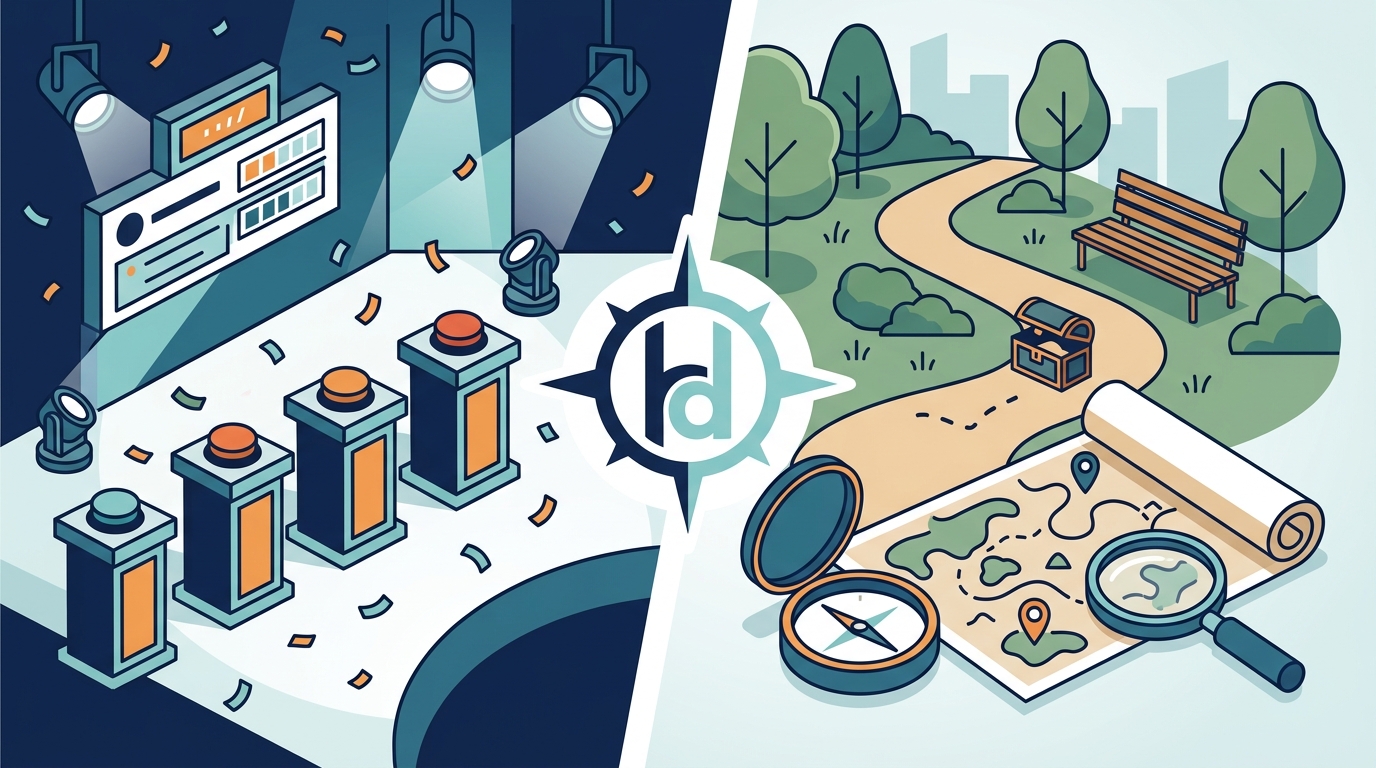
A corporate game show is a structured indoor competition where teams answer trivia, solve puzzles, and complete timed challenges under host facilitation. This format prioritizes rapid decision-making and verbal communication. Participants remain seated or stand in designated zones while rotating through activity stations. The controlled environment reduces logistical friction and allows immediate feedback. Organizations seeking high-energy interaction without weather dependency typically select this model.
Scavenger Hunt Dynamics
An outdoor city scavenger hunt is a location-based navigation challenge where teams follow clues to complete physical or digital tasks across urban environments. This format emphasizes spatial reasoning, route optimization, and field coordination. Participants utilize mobile devices or printed maps to track progress. The unstructured nature of city navigation introduces adaptive problem-solving. Companies prioritizing active movement and environmental exploration prefer this model.
Spatial Requirements and Venue Logistics
Indoor game shows require controlled venues with reliable power, audio systems, and modular seating. These spaces typically accommodate fifty to two hundred participants without requiring external permits. Event planners can secure hotel ballrooms, convention centers, or dedicated experience venues. The predictable layout simplifies catering integration and accessibility compliance. Outdoor scavenger hunts demand municipal permissions, route mapping, and safety briefings. Teams navigate public sidewalks, parks, or designated heritage districts. Weather contingencies and transit logistics directly impact execution timelines. Organizations operating in dense metropolitan areas often leverage local experience providers to manage permits and safety protocols.
Cognitive Load and Skill Application
Game shows heavily utilize working memory and rapid recall. Participants process multiple-choice questions, logic puzzles, and creative prompts under time pressure. This format activates analytical reasoning and verbal fluency. Scavenger hunts prioritize spatial mapping and procedural execution. Teams must interpret directions, manage time zones, and coordinate physical movement. This format activates executive function and adaptive planning. Research indicates that mixed-activity programs yield higher retention rates than single-format events. Selecting the appropriate cognitive load ensures participants remain engaged without experiencing decision fatigue.
Budget Allocation and Scalability Factors
Corporate game shows typically range from moderate to premium pricing depending on venue rental and custom content development. Fixed overhead costs include facilitator fees, audio-visual equipment, and printed materials. Scalability remains straightforward since participant counts rarely exceed venue capacity limits. Outdoor scavenger hunts introduce variable costs such as transportation allowances, permit fees, and mobile technology licensing. Group sizes often scale from twenty to three hundred participants. Larger deployments require additional route coordinators and safety marshals. Organizations must weigh upfront capital expenditure against long-term engagement returns.
Measuring Return on Engagement
Measuring success requires tracking participation rates, post-event survey scores, and behavioral shifts. Game shows generate immediate visibility through live scoring and audience interaction. Participants experience rapid dopamine spikes from correct answers and team celebrations. Scavenger hunts produce sustained engagement through continuous problem-solving and milestone achievements. Both formats deliver measurable improvements in cross-functional communication. Organizations that align activity selection with strategic goals report higher retention and stronger interpersonal trust.
Format Comparison Matrix
| Activity Format | Primary Skill Focus | Optimal Group Size | Duration Range | Cost Classification |
|---|---|---|---|---|
| Corporate Game Show | Verbal recall and rapid decision-making | 30 to 150 participants | 2 to 3 hours | Moderate to Premium |
| Outdoor City Scavenger Hunt | Spatial mapping and procedural execution | 20 to 300 participants | 3 to 4 hours | Moderate to High |
| Hybrid Experience Model | Adaptive problem-solving and route optimization | 40 to 200 participants | 4 to 5 hours | Premium |
Key Takeaways
- Structured indoor competitions deliver immediate visibility and rapid feedback loops for large groups.
- Location-based navigation challenges require municipal permits and weather contingency planning.
- Organizations report a 21 percent increase in cross-departmental collaboration after structured bonding events.
- Fixed overhead costs remain predictable for indoor venues while outdoor deployments introduce variable transit expenses.
- Mixed-activity programs consistently outperform single-format events in long-term retention metrics.
- Facilitator expertise directly correlates with participant engagement and safety compliance.
- Strategic alignment between activity selection and corporate objectives maximizes return on investment.
Frequently Asked Questions
Which format works best for remote or hybrid teams?
Hybrid teams benefit most from location-based challenges that incorporate digital check-ins and mobile submissions. These formats allow distributed participants to contribute simultaneously while maintaining physical safety protocols. Facilitators can monitor progress through centralized dashboards and adjust difficulty in real time.
How do you handle accessibility requirements for outdoor events?
Outdoor challenges require route mapping that accommodates wheelchair access, sensory sensitivities, and mobility limitations. Providers design alternative pathways and assign dedicated support staff to ensure inclusive participation. All physical tasks can be modified to meet compliance standards without reducing engagement value.
Can these activities be customized for specific industry sectors?
Content modules adapt to regulatory frameworks, technical terminology, and operational workflows. Financial institutions receive compliance-focused puzzles while technology firms encounter coding-based challenges. Customization ensures relevance and reinforces sector-specific knowledge during gameplay.
What is the typical cancellation policy for weather-dependent events?
Outdoor deployments include backup indoor venues or rescheduling windows within thirty days. Providers maintain flexible contracts that prioritize participant safety and schedule continuity. Organizations should verify contingency clauses before finalizing booking agreements.
How do facilitators manage large group dynamics?
Experienced coordinators divide participants into micro-teams and assign rotating roles to prevent dominance by single individuals. Structured rotation schedules ensure equitable participation and balanced workload distribution. Debrief sessions translate gameplay insights into actionable workplace strategies.
Do these programs require specialized technology or equipment?
Modern deployments utilize encrypted mobile applications for real-time scoring and location tracking. Participants typically use personal smartphones or provided tablets to submit answers. Providers handle all software licensing, hardware sanitization, and data privacy compliance.
What metrics determine post-event success?
Organizations track participation rates, post-event survey scores, and behavioral shifts in daily operations. Game shows generate immediate visibility through live scoring and audience interaction. Scavenger hunts produce sustained engagement through continuous problem-solving and milestone achievements.
Book Your Next Corporate Event
Select the format that aligns with your strategic objectives and operational constraints. Our experienced coordinators design customized programs that prioritize safety, engagement, and measurable outcomes. Visit our team building catalog to explore available modules. Review our premium venues to secure optimal spaces. Contact our planning specialists at schedule a consultation to finalize your event parameters. Explore our latest insights for planning guidance. Secure your preferred date by visiting hiddendoor.com.au today.