

Low employee engagement is not merely a morale issue. It is a structural failure in organizational design that costs businesses billions in lost productivity annually. According to recent workplace analytics, disengaged employees contribute to a significant percentage of global economic output loss. Traditional team building often fails because it prioritizes forced fun over genuine connection. This guide provides a strategic framework for implementing corporate team building that respects professional boundaries while delivering measurable ROI.
Diagnosing the Root Cause of Disengagement
Before selecting an activity, you must understand why engagement has dropped. Disengagement rarely stems from a single event. It is usually the result of chronic misalignment between individual values and organizational goals. When teams feel disconnected, they withdraw emotionally. This withdrawal manifests as reduced collaboration and increased turnover.
Research indicates that companies with highly engaged teams show a 21% increase in profitability. This statistic highlights that engagement is a financial imperative, not just a cultural luxury. To reverse this trend, you must move away from generic icebreakers. You need experiences that trigger genuine psychological safety.
Psychological safety is the belief that one will not be punished or humiliated for speaking up with ideas, questions, concerns, or mistakes. Without this foundation, any team building activity will feel performative. Employees perceive forced interaction as a violation of their professional autonomy. This perception creates the "cringe" factor that undermines the entire initiative.
Defining Anti-Cringe Team Building
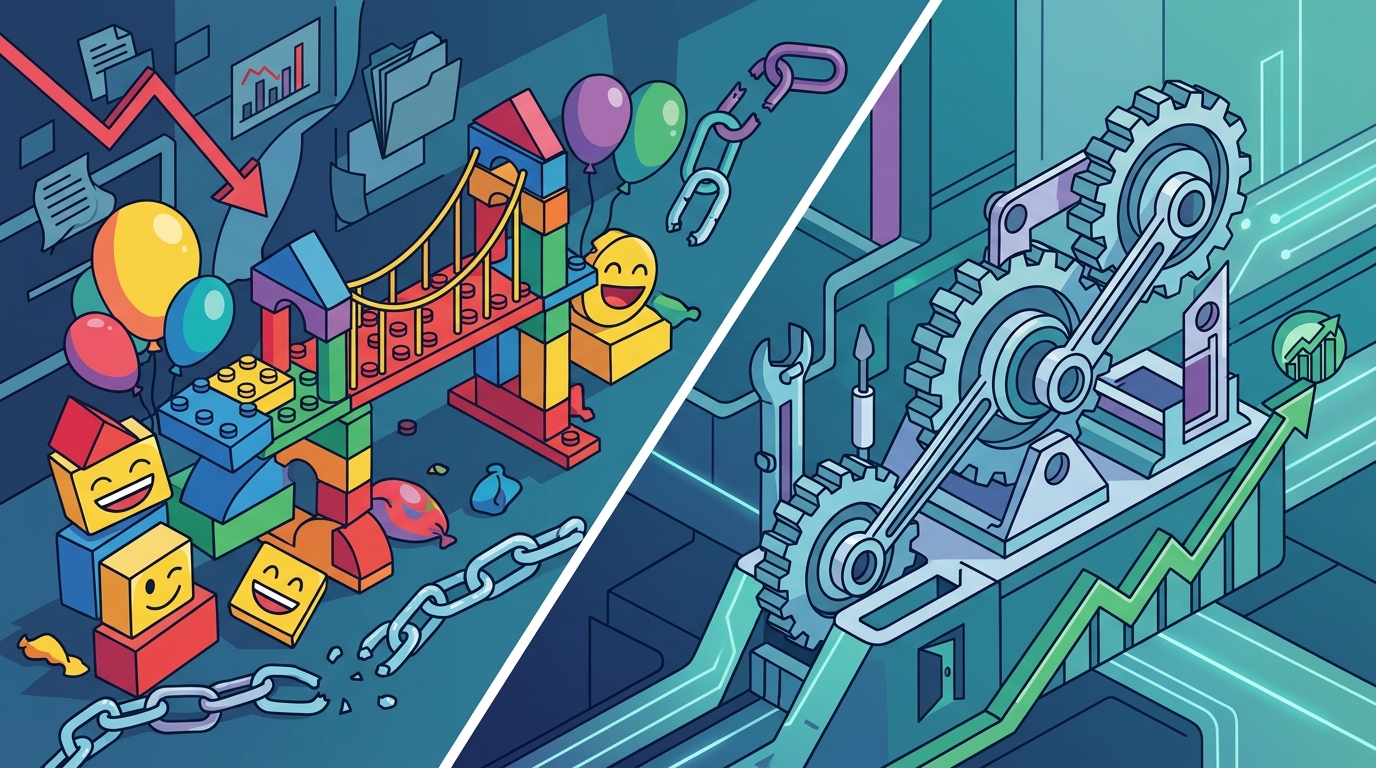
What exactly constitutes "anti-cringe" team building? It is not a specific activity type. It is a design philosophy. Anti-cringe experiences are defined by three core principles: autonomy, relevance, and respect for time.
Autonomy means giving employees choices. Forced participation in awkward physical challenges creates resentment. Allowing teams to select their own challenges fosters ownership. Relevance ensures the activity mirrors real-world work dynamics. Abstract games that have no connection to daily tasks feel like a waste of time. Respect for time means the experience is concise and impactful. Marathon sessions that drag on lose their energy and value.
Hidden Door Experiences specializes in this exact philosophy. Their approach focuses on creative challenges that allow teams to express themselves without the pressure of forced socialization. By removing the element of performance, you remove the cringe. This allows genuine collaboration to emerge naturally.
The Strategic Framework for Success
Implementing effective team building requires a structured approach. You cannot simply book a vendor and hope for the best. You must align the experience with specific business outcomes. This section outlines the four-step framework for success.
Step 1: Define the Objective
Start by identifying the specific gap in your team dynamics. Is it a communication breakdown? A lack of trust? Or simply a need for creative stimulation? Your objective dictates the activity. For example, if you need to improve cross-departmental collaboration, you should choose activities that require diverse skill sets. If you need to boost morale after a stressful period, focus on low-stakes creative play.
Step 2: Select the Format
The format must match your team's personality. Introverted teams may prefer indoor, structured challenges. Extroverted teams might thrive in outdoor adventures. Hidden Door Experiences offers a wide range of formats, including indoor team building and outdoor team building options. The key is to avoid one-size-fits-all solutions.
Step 3: Curate the Experience
Choose activities that are novel and engaging. Repetitive activities lose their impact. Look for experiences that involve creation, problem-solving, or strategic planning. For instance, Brick Masters challenges teams to design and pitch LEGO creations. This activity is engaging because it is tactile and creative. It allows for different types of intelligence to shine.
Step 4: Debrief and Integrate
The learning happens in the debrief. Facilitators must guide the team to connect the activity to their daily work. Without this step, the experience remains a fun day out with no lasting impact. Ensure your vendor provides structured debriefing sessions that highlight key takeaways.
Comparing High-Impact Activity Models
Not all activities deliver the same value. Below is a comparison of three high-impact models that avoid the cringe factor. Each model serves a different strategic purpose.
| Activity Model | Best For | Key Benefit | Example Experience |
|---|---|---|---|
| Creative Construction | Breaking down silos | Encourages non-verbal collaboration | Brick Masters |
| Strategic Narrative | Building trust | Reveals individual strengths | Breaking Barriers |
| Immersive Adventure | Boosting energy | Creates shared memories | The Amazing Race |
Creative construction activities like Brick Masters are particularly effective for technical teams. They allow engineers and developers to showcase spatial reasoning skills. This builds respect among colleagues who may not understand each other's daily work. Strategic narrative experiences like Breaking Barriers are ideal for leadership teams. They help identify and dismantle personal and professional obstacles.
Immersive adventures provide a high-energy environment. They are excellent for teams that need a boost in morale. However, they require careful facilitation to ensure inclusivity. Not all employees enjoy physical challenges. Always provide alternatives or modifications for those who need them.
Key Takeaways for HR Leaders
- Engagement is Financial: Disengagement costs businesses significantly. Investing in quality experiences pays for itself.
- Avoid Forced Fun: Autonomy reduces resistance. Let teams choose their challenges.
- Focus on Creation: Creative activities foster deeper connections than competitive games.
- Debrief is Critical: Without reflection, learning is lost. Ensure structured debriefs are included.
- Customize the Format: Match the activity to your team's personality and preferences.
- Vendor Expertise Matters: Choose providers who understand organizational psychology.
- Measure the Impact: Track engagement metrics before and after the event.
Frequently Asked Questions
How do I know if my team building was successful?
Success is measured by behavioral change, not just enjoyment. Look for increased collaboration, improved communication, and higher energy levels in the weeks following the event. Hidden Door Experiences provides tools to help you track these metrics.
Can team building work for remote teams?
Yes, but it requires a different approach. Virtual team building must be highly interactive to combat screen fatigue. Hidden Door Experiences offers virtual team building options that are designed to be engaging and inclusive.
What is the ideal group size for team building?
The ideal size depends on the activity. Smaller groups allow for deeper interaction. Larger groups require more complex facilitation. Most activities can be scaled to fit your team size.
How long should a team building event last?
Shorter, more intense experiences are often more effective than all-day events. A half-day session can be more impactful than a full day. This respects your team's time and maintains high energy levels.
Is team building expensive?
Cost varies based on the activity and location. However, the ROI of improved engagement often outweighs the cost. Consider the cost of turnover and lost productivity as a comparison.
What if my team is resistant to team building?
Resistance is common. Address it by explaining the "why" behind the event. Involve team members in the planning process. Choose activities that are relevant to their interests.
Do you offer corporate retreats?
Yes, Hidden Door Experiences offers corporate retreats in various locations. These retreats combine team building with strategic planning and relaxation.
Book Your Strategic Session
Stop wasting budget on ineffective activities. Start building a culture of genuine engagement. Hidden Door Experiences is Australia's leading provider of anti-cringe team building. We design experiences that respect your team while delivering results. Visit our contact page to discuss your specific needs. Or explore our blog for more insights on workplace culture.